Research at the Lab
We seek to improve the quality of governance by generating scientific knowledge on how regulators and society interact, and by translating this knowledge into evidence-based guidance for credible and citizen-centric regulation.
Research focus
At the Regulatory Behavior Lab, we study how regulation operates in practice rather than solely as formally prescribed (de facto vs. de jure). Next to focusing on formal rules and institutional design, we examine regulation as an interactive social process shaped by decisions, communication, bureaucratic discretion, and everyday encounters between regulators and the public.
Our research investigates the micro-level behavior of regulatory authorities and the behavioral responses of citizens and stakeholders to regulatory actions and outputs — such as rules constraining industry or citizen behavior. We analyze how regulators make decisions, justify them, and communicate them, and how these actions influence trust, legitimacy, organizational reputation, and compliance.
A central premise of the Lab is that regulatory outcomes are co-produced. They depend not only on legal mandates and formal authority, but also on how regulatory actions are perceived, interpreted, and (emotionally) experienced by citizens and stakeholders.
Integrating insights from public administration, political science, psychology, and behavioral science, the Lab advances theory on regulatory behavior and citizen-centric governance as well as seeks to generate evidence-based guidance for regulatory authorities seeking to act effectively, credibly, and responsively in complex and uncertain societal environments.
Core research themes of the Lab:
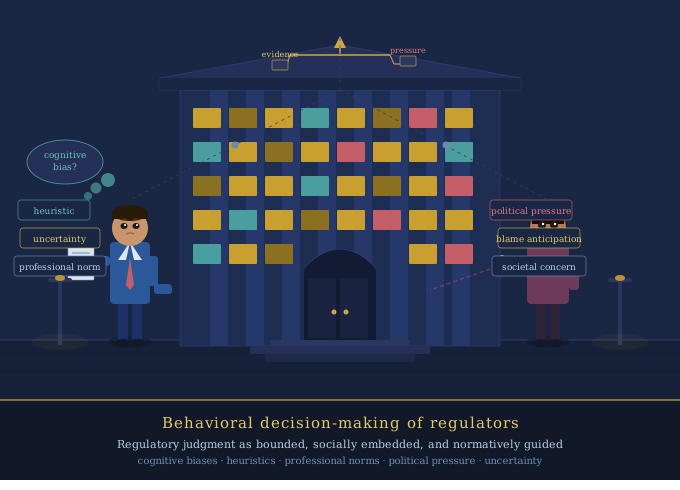
Behavioral decision-making of regulators
We examine regulatory judgment as bounded, socially embedded, and normatively guided decision-making rather than purely rule-following behavior.
Research topics include:
- The role of cognitive biases, emotions, heuristics, and professional role conceptions in responsiveness decisions
- Decision-making under uncertainty, including risk interpretation, blame anticipation, and strategic responses to societal and political pressure
- Organizational practices and governance arrangements that sustain legitimacy, reputation, and credible authority
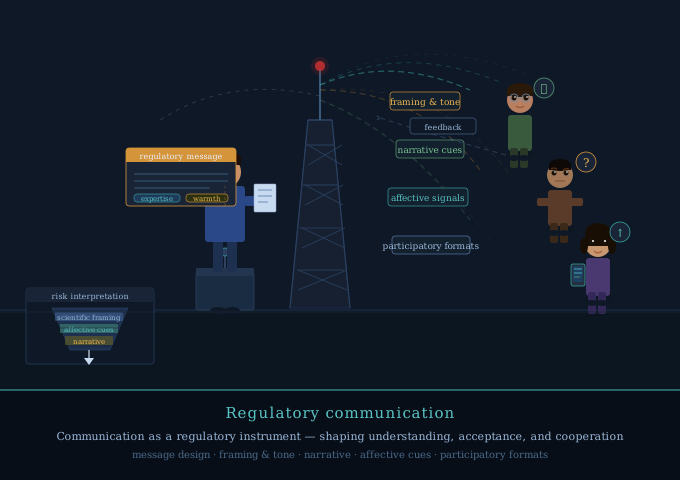
Regulatory communication
We study communication as a regulatory instrument through which authorities shape understanding, acceptance, and cooperation.
Research topics include:
- Design of regulatory messages that convey expertise, warmth, and responsiveness
- Effects of framing, tone, and participatory formats on policy acceptance
- The use of narratives and affective cues to guide risk interpretation and foster cooperative relationships with stakeholders
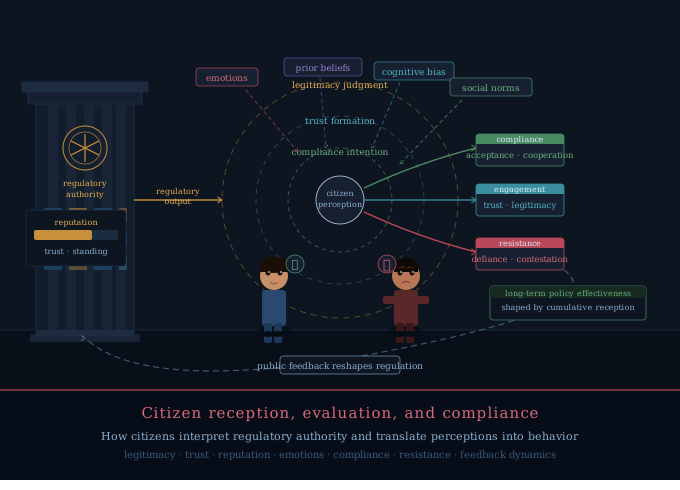
Citizen reception, evaluation, and compliance
We analyze how citizens interpret regulatory authority and translate perceptions into behavior.
Research topics include:
- Formation of legitimacy, trust, and reputation judgments based on interactions with regulators
- The role of emotions, prior beliefs, cognitive biases, and social norms in compliance, resistance, and engagement
- Feedback dynamics through which public reactions reshape regulatory practices and long-term policy effectiveness
Methods
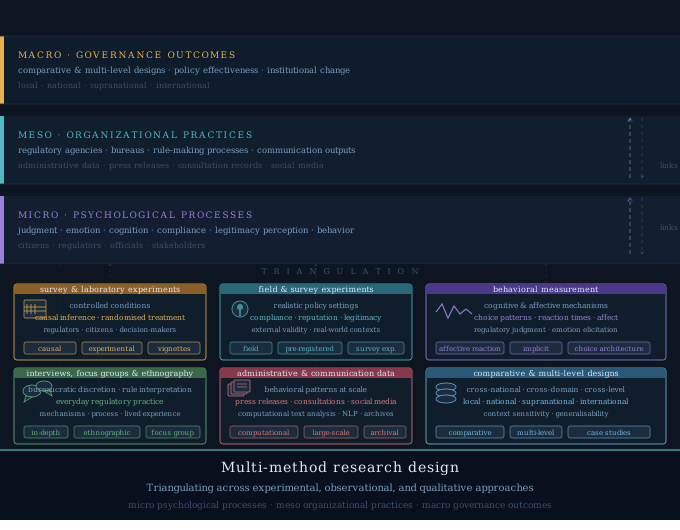
Research at the Regulatory Behavior Lab employs a multi-method and mixed-method designs to capture regulatory behavior as it unfolds in real-world contexts while also allowing for causal inference about underlying mechanisms.
We combine experimental, observational, and qualitative approaches:
-
Survey and laboratory experiments to identify how decision-makers and citizens respond to regulatory choices, communication strategies, and cues under controlled conditions
-
Field and survey experiments to examine compliance, organizational reputation, and legitimacy in realistic policy settings
-
Behavioral measurements (for example choice patterns and affective reactions) to uncover cognitive and affective mechanisms underlying regulatory judgments
-
Interviews, focus groups, and ethnographic observation to study bureaucratic discretion and interpretation of rules in everyday regulatory practice
-
Administrative and communication data analysis (press releases, consultation responses, social media communication) to assess behavioral patterns at scale
-
Comparative and multi-level designs spanning local, national, and international regulatory authorities
By triangulating across methods, the Lab links micro-level psychological processes to organizational practices and macro-level governance outcomes, enabling both theoretical development and evidence-based policy guidance.
Empirical Scope
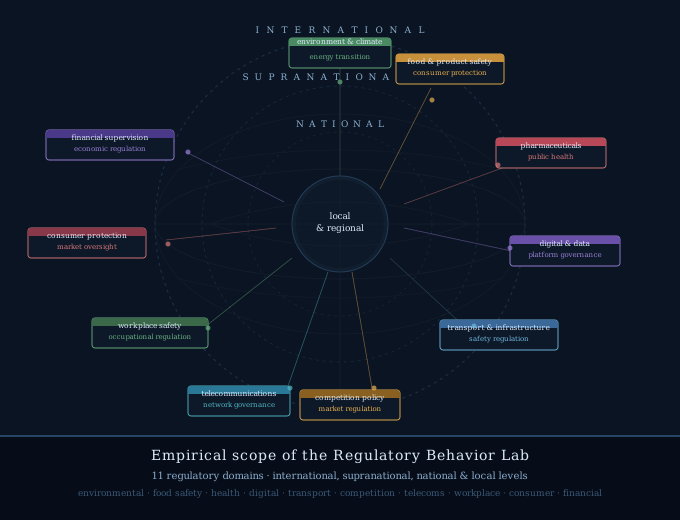
The Lab focuses on diverse regulatory domains, including environmental protection, climate and energy transition, financial supervision, consumer and market protection, food and product safety, pharmaceuticals and public health, digital platform and data governance, transport and infrastructure safety, competition policy, telecommunications, and workplace and occupational safety. We study regulators operating at international, supranational (for example, European Union agencies), national, and local levels.
Maak jouw eigen website met JouwWeb